Design
Designing Through Winter
How our virtual design process actually works
Winter is when concept plans, grading studies and plant palettes finally get the attention they need.
Every October, the same shift happens: crews start coming off-site for the season, install lists get shorter, and it would be easy to assume the studio goes quiet along with the yards. It doesn't. If anything, this is when the design table gets busier — because winter is when the actual thinking happens.
Concept plans, grading studies, plant palettes for next spring — the work that's easy to skip when you're managing five install crews in July finally gets the attention it needs once the ground starts to freeze.
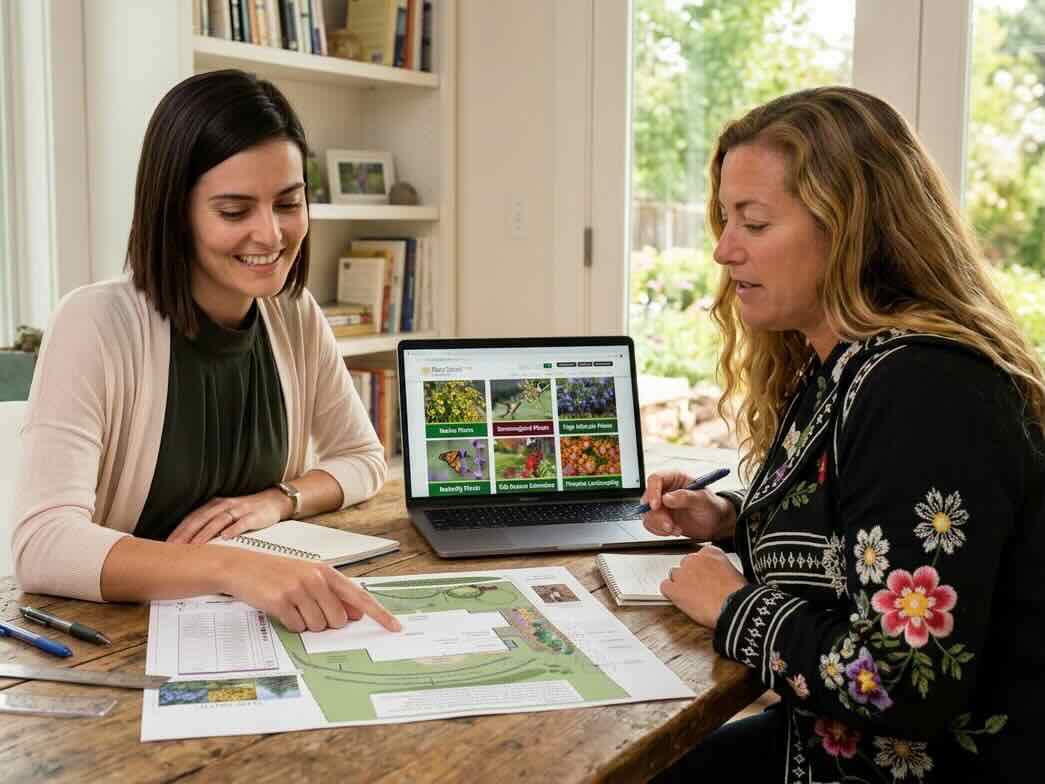
That shift is also why this is the right month to talk plainly about something we haven't spent much time explaining: for a growing number of our clients, "sitting down with a designer" doesn't always mean standing in your backyard. It means a a virtual landscape design process: a video call, a set of site photos, and a shared set of drawings — sometimes for a landscape hundreds of miles from Durango.
How the virtual landscape design process actually works.
"Slow season" has always undersold what late fall and winter actually are for a studio like ours, in the same way "fall cleanup" undersold what September's work really was. Here's what shifts as installation winds down:
- Concept development — early sketches, grading studies, and plant palettes for projects that will break ground next spring.
- Client meetings — walking through drawings and revisions with the level of attention that's hard to give mid-summer.
- Coordination with Barnabas — our licensed landscape architect, brought in whenever a project needs a stamped grading or drainage plan (more on that below).
- Remote site work — reviewing photos, video walkthroughs, topo data, and survey documents for properties we're designing without ever having stood on them.
None of this is a consolation-prize version of what happens on-site in summer.
It's the part of the process that determines whether the on-site work goes well.
How the virtual design process actually works
We get some version of this question every winter: can you really design a landscape you haven't walked? The honest answer is that a significant part of any design — reading grade, drainage patterns, sun exposure, soil, and how water actually moves across a site — has to happen before a shovel goes in the ground, whether we're standing on the landscape or not. Here's what that process looks like, start to finish:
- Site documentation. You send photos and a video walkthrough of the landscape, along with any topo or survey data you have. We tell you exactly what to capture and from where — this step matters more than most people expect.
- A working call with a designer. We walk through the footage together, ask questions about how you use the space, and talk through what's realistic for your climate, elevation, and budget. If the project involves grading or drainage — a common need at altitude — Barnabas joins this conversation.
- Concept plans. You get a set of drawings: layout, plant palette, materials, and a narrative explaining the reasoning behind each decision, not just a plan to approve or reject.
- Revisions. Design is iterative in person and it's iterative here too — most projects go through two or three rounds before the plan is right.
- A build-ready package. The final deliverable is something a local contractor, or our own crew where we're in range, can actually execute from — construction drawings, planting plans, and material specifications.
Why this travels well beyond Durango
The principles behind our work were never really Durango-specific — they're arid, high-elevation, water-first design principles that apply anywhere in the Rockies dealing with the same fundamentals: scarce water, wildfire exposure, thin or compacted soil, and short growing seasons. A crevice garden built to work with rock and slope instead of flattening it doesn't stop working outside La Plata County. Neither does a seating wall doing three jobs at once, or a grading plan built to bank rainwater instead of shedding it.
That's the design logic clients are hiring for, whether the landscape is outside Durango, in Telluride, Jackson Hole, Park City, Santa Fe, or Sun Valley — and it's exactly the logic our virtual process is built to deliver without requiring us to be standing on-site.
When licensing actually matters
We wrote back in July about the difference between design work that can stay DIY-adjacent and work that needs to become licensed, technical work — stamped grading plans, drainage calculations, anything where getting it wrong has real consequences. That distinction matters even more for remote projects, where we're not there to catch a grading problem by eye. This is exactly the kind of project where Barnabas Kane, PLA, gets pulled into the virtual process early, not as an afterthought.
Two ways to start
Whether you're local to Durango or reading this from a landscape a few states away, winter is the right time to start the conversation about next year.
Frequently Asked Questions
Can you really design a landscape without visiting the property?
For the parts of design that matter most up front — grading, drainage, plant selection, layout — yes, provided we get good site documentation. What virtual design can't replace is being there for the physical build; that's why the final deliverable is built for your local contractor or crew to execute from.
What do I need to provide to get started with virtual design?
Site photos, a video walkthrough, and any survey or topo data you have. We'll tell you exactly what angles and detail to capture before you start filming.
Do you offer virtual design outside Colorado?
Yes. We work with clients across the Rocky Mountain states — including mountain towns like Telluride, Jackson Hole, Park City, Santa Fe, and Sun Valley — wherever the same high-elevation, arid-climate design challenges apply.
How is virtual design different from just sending someone a Pinterest board?
The process still includes a working call with a designer, real drawings specific to your site's grade and conditions, and revisions — not a mood board. It's the same design thinking we use on local projects, adapted to work remotely.
When does a virtual project need a licensed landscape architect involved?
Whenever grading or drainage is part of the scope. Barnabas joins remote projects at the same point he'd join a local one — early, before concepts are finalized.
Is winter really the best time to start this process?
It's the best time to start planning. Installation work naturally slows through winter, which means more attention on concept development, revisions, and getting a build-ready package finished before the spring rush.