Design
When Do You Need a Licensed Landscape Architect & Why We Added One to Our Team
Introducing Barnabas Kane, Consultant Landscape Architect PLA

Barnabas Kane, Consultant Landscape Architect PLA
At Columbine Landscapes Co, we've always believed that great landscapes start by understanding the land.
Where does water flow? Where does it linger? How can a landscape provide beauty, habitat, and resilience all at once?
That's why we're excited to introduce Barnabas Kane, our consulting licensed landscape architect.
Bringing Barnabas into the fold strengthens our ability to serve clients whose projects require a deeper level of site planning — while staying firmly rooted in our core philosophy: landscapes should be beautiful, functional, regenerative, and uniquely adapted to the place they inhabit.
Below, we also answer a question:
When do you need a licensed landscape architect, as opposed to an unlicensed landscape architect, landscape designer or contractor?
It matters more here than in most places — our dry climate, mountain runoff, and wildfire exposure raise the stakes on getting site planning right.
Meet Barnabas
What makes Barnabas such a natural fit isn't just his professional credentials. He's also a Permaculture Design Certificate instructor and a passionate advocate for landscapes that harvest water, build soil, and work in partnership with natural systems.
Adding a licensed landscape architect allows us to support projects that require closer coordination with architects, engineers, and permitting agencies. Our foundation remains ecological design and land stewardship — but Barnabas expands our ability to take on more complex projects, where technical drawings, grading plans, and construction detail are essential to getting the outcome right the first time.
Read more about Barnabas here →
When do you need a licensed landscape architect?
Not every project needs one, and for many of the scenarios below our design professionals work in tandem with Barnabas. Some municipalities require that site and/or landscape plans be prepared by a licensed landscape architect (or other state registrant), so that the design meets ‘public health, safety and welfare’ requirements as a minimum standard. Here's when:
Does your site have serious grading or drainage challenges?
Steep lots, seasonal runoff from snowmelt, and thin mountain topsoil mean water moves fast and takes soil with it when it does. A landscape architect can complement our rainwater harvesting practices with grading and drainage engineered to direct water exactly where you want it — into a rain garden or swale, rather than into your foundation or your neighbor's yard.
Are you planning large-scale retaining walls?
Retaining walls over a certain height, hardscape adjacent to a foundation, or any landscape element that interacts with a building's structure typically requires a stamped plan for permitting. A good rule of thumb is retaining walls over two feet in height, where engineering and permitting requirements come into play. This is where a landscape architect's license — not just design skill — becomes a legal requirement.
Are you working with an architect, engineer, or contractor on a larger build?
New construction, additions, and major remodels usually involve a design team. A landscape architect speaks the same technical language as architects and civil engineers, and can produce the site plans, grading plans, and construction documents that keep everyone coordinated and the project moving through permitting without delays.
Is your property in a wildfire-prone area?
Much of southwest Colorado sits in the wildland-urban interface, and defensible space planning — clearing zones, fire-adapted plant selection, spacing — is something our design team builds into every project, drawing on current county and Firewise USA guidelines. Most residential properties don't need a stamped plan for this. Where Barnabas's involvement becomes valuable is when a defensible space or fuel-mitigation plan needs formal sign-off — for county permitting, insurance requirements, or larger and multi-structure properties — or when grading and hardscape near a structure become part of the fire mitigation strategy itself.
Do you need to navigate permitting, HOA review, or county requirements?
Many mountain communities have design review boards, water-use restrictions, or grading permits that require professional documentation. A licensed landscape architect can prepare submittals that meet these standards and represent the project through the approval process.
Do you want to harvest and manage water on-site?
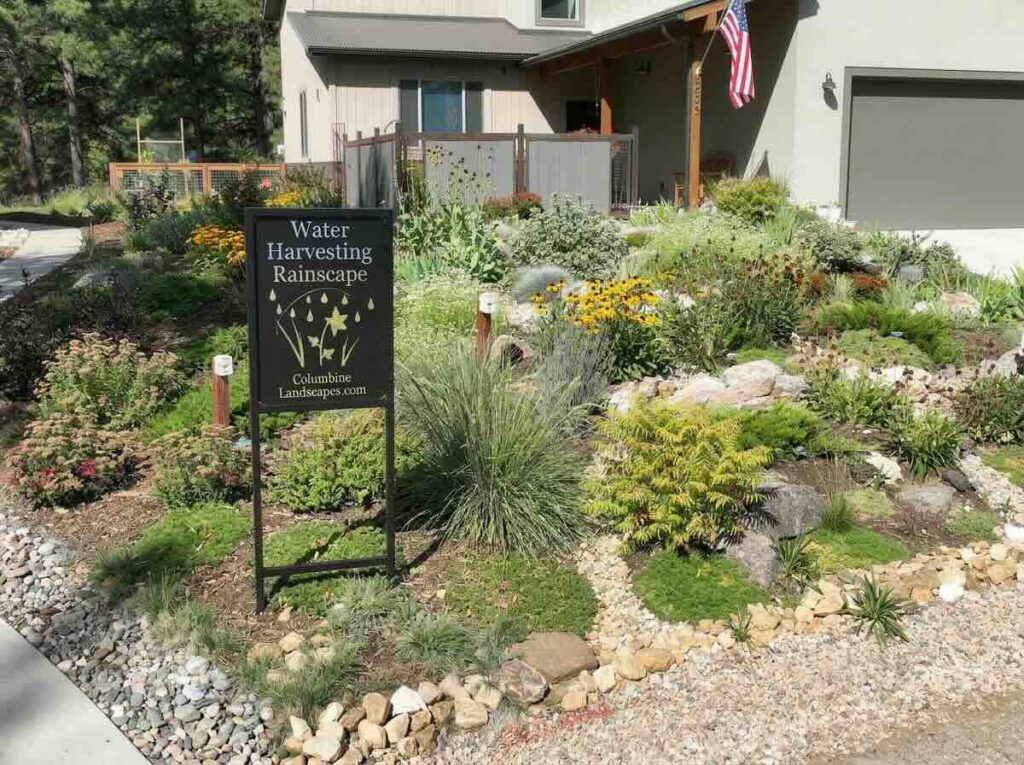
In a region where every inch of rainfall counts, systems like rainwater catchment, greywater reuse, and engineered swales need to be sized and placed correctly to work — and, in many cases, to meet code. Our landscape designers are all rainwater-harvesting certified, and building these systems into new installations is fundamental to how they work every day. For the vast majority of projects, our design team has this fully covered! Barnabas brings additional expertise when the scale of earthworks crosses a certain threshold.
Read more about our approach to rainscapes here →
Is your project large, phased, or multi-structure?
Ranch properties, developments, and multi-building sites benefit from a master plan that sequences work over time and ensures each phase supports the next — rather than a landscape assembled piecemeal that never quite fits together. While this is work our team handles, it can prove useful to have a licensed landscape architect at the ready if and when the need arises.
The bottom line
If your project involves major structural elements, drainage engineering, permitting, or coordination with a multi-discipline team, a licensed landscape architect isn't a luxury — it's often the difference between a landscape that performs for decades and one that needs to be re-engineered in five years.
If you're not sure which category your project falls into, that's exactly the kind of question we're happy to talk through. Reach out, and we'll help you figure out what level of planning your site actually needs.
The best designs don't impose themselves on the land. They reveal what's possible when we listen to it.
Service note — 2026 season
When to involve a landscape architect.
A landscape architect becomes essential once a project moves beyond aesthetics into engineering, safety, or regulatory territory. Because landscape architects are licensed professionals trained in grading, drainage, structural elements, and code compliance, they're the right call for projects involving retaining walls above a certain height, significant elevation changes, stormwater management, erosion control, or any hardscape that needs to bear real structural load.
Read more about Barnabas here →